
Liverpool
Bournemouth’s disallowed goal was incorrectly ruled offside, with the offside line appearing to be deliberately altered. Gary Neville, after watching the full Bournemouth vs. Liverpool match from his apartment, has presented strong evidence supporting why the goal should have stood.

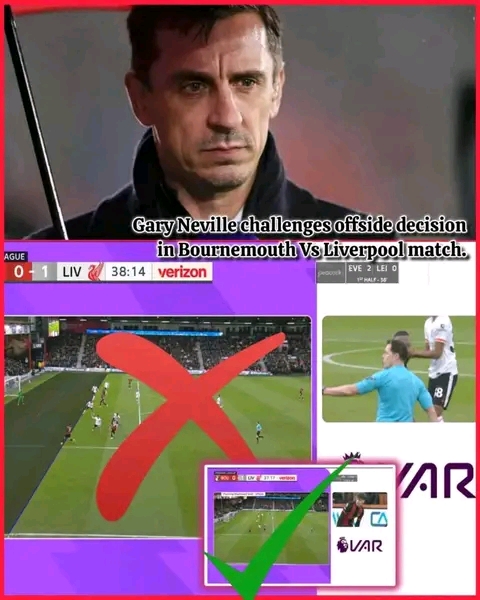
A contentious offside decision in the recent **Premier League encounter between Bournemouth and Liverpool** has sparked widespread debate among football fans and analysts. The controversy revolves around a **disallowed Bournemouth goal**, with many questioning the accuracy of the **offside line used by VAR**. Critics argue that the line appeared to be **misaligned or manipulated**, leading to further scrutiny of the consistency in officiating decisions.
One of the most vocal critics of the decision is **former Manchester United defender and football pundit Gary Neville**, who strongly believes the goal should have been allowed to stand. Neville presented his case using **video evidence** during his analysis on **Sky Sports’ Monday Night Football**, where he examined the incident in detail.
Neville, who **watched the full 90 minutes from his apartment**, revisited the disallowed goal and pointed out what he believes to be a crucial error in the VAR review. According to his analysis, the Bournemouth attacker was **onside at the moment the ball was played**, yet the **VAR offside line appeared incorrectly placed**, resulting in the goal being ruled out. He emphasized that **inaccuracies in VAR implementation** have the potential to unfairly alter match outcomes and called for **greater transparency and precision in refereeing decisions**.
To support his argument, Neville referenced a **similar incident from August 2015**, when Liverpool secured a **1-0 victory over Bournemouth**. In that match, **Christian Benteke’s goal was allowed to stand**, despite **Philippe Coutinho being offside and interfering with play**. At the time, both Neville and his fellow pundit **Jamie Carragher criticized the referees**, arguing that Coutinho’s position **impacted the goalkeeper’s ability to react**, making it an instance of clear interference.
Reflecting on how the offside rule has evolved over the years, Neville voiced his frustration, stating, **”They mess with the offside rule every year, and it never improves.”** His remarks highlight the ongoing issues surrounding the interpretation and implementation of offside decisions in modern football.
Neville’s in-depth breakdown of the disallowed Bournemouth goal raises serious concerns regarding the **credibility of the VAR system**. His **frame-by-frame analysis** suggests that the **offside line was either misapplied or altered**, leading to what he sees as an **incorrect decision**. Given how crucial such moments are in determining match results, questions are being raised about **the reliability and fairness of VAR** in key situations.
This controversy has reignited broader discussions about **VAR’s effectiveness and the application of offside rules** in football. Many fans and analysts are now advocating for **clearer guidelines, enhanced technology, and greater consistency** to ensure fairer outcomes.
As of now, the **Professional Game Match Officials Limited (PGMOL)**, the governing body responsible for overseeing referees in English football, has not issued an official statement on the matter. However, the ongoing debate highlights the urgent need for **continuous review and refinement of VAR protocols** to preserve the **integrity of the game**.
Gary Neville’s analysis has added to the growing discourse on how football should **better integrate technology with rule enforcement** to minimize controversial decisions and ensure **a more transparent and just system** for all teams.
admin
Website
-

 Barcelona7 months ago
Breaking News: Anfield is buzzing with excitement! Raphinha has reached a personal agreement with Liverpool. Barcelona is reportedly willing to let him go, and in a recent interview, Raphinha hinted at his admiration for the incoming manager, saying, “If Arne Slot calls, you pick up.”
-

 Premier League7 months ago
Xavi Hernandez has officially signed a three-year contract to become the new head coach of a Premier League club, stepping in after the departure of the previous manager
-
 Real Madrid8 months ago
Jurgen Klopp Reveals Why He Accepted Real Madrid’s Offer to Replace Carlo Ancelotti
-

 Liverpool5 months ago
Despite the heartbreak caused by Diogo Jota’s tragic accident, Liverpool FC has brought a glimmer of hope to his grieving family — especially his wife and the three beautiful kids he left behind
-

 Manchester United8 months ago
BREAKING NEWS: Lisandro Martinez spotted in Man United training yesterday as Club doctor confirmed Him fit to start against Lyon – Congratulations Man United fans
-
Manchester United8 months ago
I’m not suppose to be doing this but as A captain it pains me to see such a great player with potential leave our club,I shed tears when the INEOS announced His departure,this very unfair of Him”, Bruno Fernandez broke down in tears as INEOS confirmed another Man united player departure by the summer
-
 Manchester United8 months ago
BREAKING NEWS: Antony Santos Reveals Ruben Amorim’s “Unfair” Conditions for Manchester United Return.
-
 Manchester United8 months ago
I’m sorry to say this but He can no longer work with me anymore, He’s suspended till transfer window opens”, Ruben Amorim have suspended one Man United player from training activities till transfer window opens after His disastrous performance last night